

The Art of Improvisation
Juneteenth, jazz, and freedom
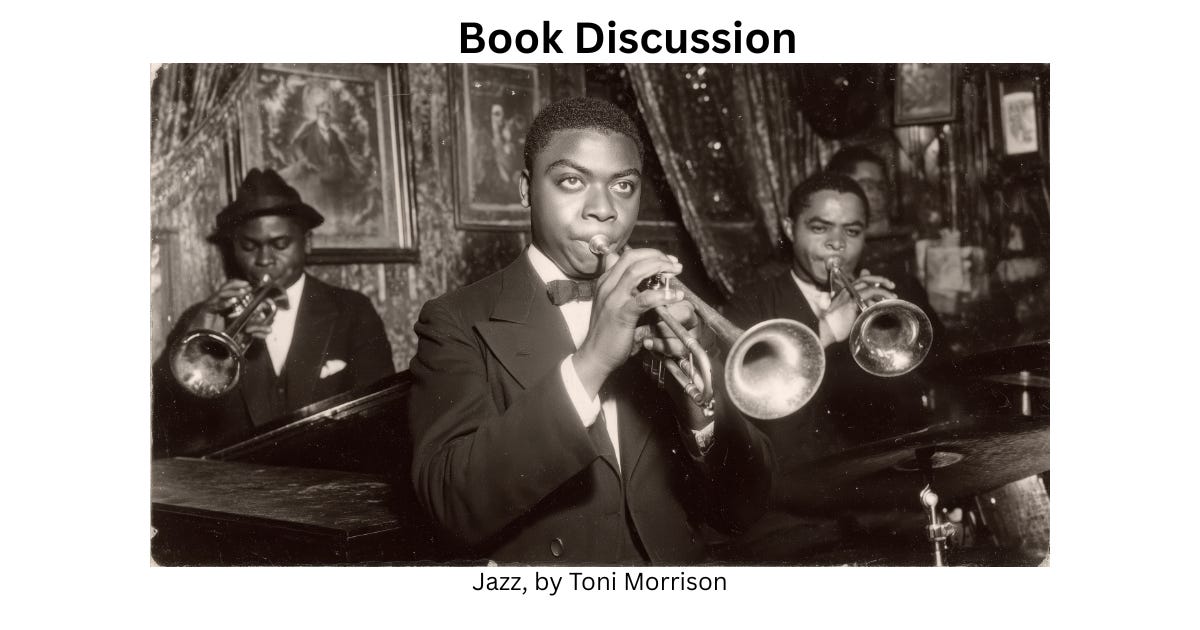

Does freedom have a sound?
For many, the answer is yes, and it sounds like jazz.
In honor of Juneteenth, readers, writers, and lovers of Black literature are invited to join a virtual discussion on June 27th @ at 3 pm EST of Toni Morrison’s Jazz—the novel that captures the improvisational spirit of the musical genre while exploring love, migration, memory, longing, and the possibilities of reinvention—with Afro•Reads and me!
Published in 1992 and set in Harlem in the 1920s, Jazz is an innovative work. Like the genre, it moves like an ensemble: voices enter and depart, stories overlap, truths shift, and memories return in unexpected ways. Akin to life, it abandons the certainty of a single narrator and instead creates a literary composition that swings, riffs, and improvises.
Like jazz music itself, the novel is deeply rooted in Black history and creativity; born (and ostensibly bred) in New Orleans, it is a Black American musical tradition, and a language of innovation, resilience, experimentation, and freedom.
As a musical genre, jazz is the transformation of inherited structures into something entirely new, a means of finding expression through improvisation, call-and-response, and collective creation. It is America’s only true/original art form ~ everything else is stolen!
Morrison accomplished something similar on the page by crafting a novel that feels less like a conventional narrative and more like a performance.
As we gather during the Juneteenth season, let’s also consider the relationship between freedom and self-invention by exploring:
Cultural and historical crossroads
The Great Migration and Black urban life
Love, obsession, betrayal, and forgiveness
Memory, storytelling, and collective history
The importance of Black cultural expression
Whether you are reading Jazz for the first time or returning to it after many years, all thoughtful readers are welcome. But to participate, you must register here in advance because the Zoom link will only be provided to registered attendees.
Bring your copy of the novel, your questions, favorite passages, and your willingness to follow the music wherever it leads. Because sometimes the best conversations—like the best jazz performances—begin with a theme and become something unexpected.
We hope you’ll join us at the (virtual) table.
 | A guest post by
|