

Discretionary, Silent and Violent
Pyrite isn't gold

Hi Friends:
Because reading is a simple mix consisting of a 1:1:1 ratio, this issue includes:
Libation…
It is a given that climbing The Hill in heels consists of three parts effort, two parts willpower, and one pair of ruined shoes; therefore, the muse will drive every time…
“Words themselves are innocuous; it is the consensus that gives them true power.” – Gloria Naylor
Literary commentary…
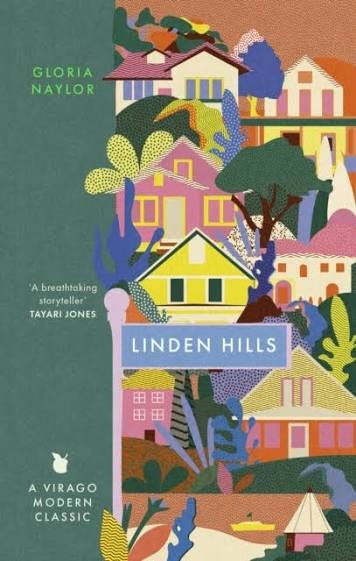
I know myself well enough to say that fictional stories about Black affluence contain a hint of truth. That is why I did not read Gloria Naylor’s Linden Hills as a novel about wealth. I read it as a novel about passive-aggressive acquiescence.
Originally published in 1985, it raises many questions; however, one remains culturally urgent decades later: To be accepted, what must Black people surrender? For some, the answer is devastating. Domination is preferable because it involves slow, deliberate erasure.
Much like its inhabitants, the neighborhood of Linden Hills presents itself as the fulfillment of the American Dream. Beautiful homes, professional success, educational attainment, impeccable appearances, and a dollop of carefully curated respectability.
Yet the deeper I moved into the novel, the less it resembled paradise and the more it reminded me of a citizen-led police state.
“The greatest prison was not behind bars, but within the mind.”
The residents are not simply successful; they are, in effect, non-existent.
Akin to real life, in Linden Hills upward mobility requires unlearning and purposely losing consciousness of one’s upbringing. Individuals forget the selves they once imagined becoming because every promotion, every acquisition, every social advancement seems to demand another sacrifice until identity itself becomes negotiable.
What initially appears to be aspiration gradually reveals itself as performative erasure, and the anxiety permeating Linden Hills is not merely fear of failure. It is the direct offshoot of living under expectations structured by interracial classism, colorism, elitism, and the relentless demand to prove one’s worth.
An expose of Black success measured by proximity to whiteness rather than wholeness, as in most Black communities, Linden Hills is home to psychologically exhausted residents.
“In Linden Hills they could forget that the world said you spelled black with a capital nothing.”
Depression runs through the novel not merely as a condition but as the emotional consequence of living in a community where authenticity conflicts with acceptability. Characters who possess outward markers of achievement remain profoundly isolated because attaining status requires suppression of grief, vulnerability, history, and desire.
Set in a community landscaped with quiet despair, the residents are not allowed to fail, feel, or remember. And the silence itself is a form of violence.
Accordingly, hierarchies are not accidental. Colorism quietly organizes belonging within the community. Lighter skin, refined presentation, educational prestige, and social polish function as forms of cultural capital, reinforcing hierarchies that mirror the racial logics imposed from outside. Inherited standards of value reproduce oppression.
This is where interracial classism becomes particularly revealing.
“To be truly free, one had to first acknowledge their chains.”
Despite its age, the novel suggests that Black middle-class respectability is all too often judged through the lens of Eurocentric norms of beauty, professionalism, and success. In addition, it implies that assimilation becomes aspirational, even as it remains emotionally corrosive because it fails to dismantle those standards; rather, it rewards those who master them.
What makes Naylor’s critique especially incisive is that she refuses easy binaries. The danger does not come solely from white supremacy. It also emerges from the ways marginalized communities internalize and reproduce its value system.
As a reader, one of the novel’s most haunting concerns is misogynoir.
The women of Linden Hills are expected to preserve appearances while quietly shouldering extraordinary emotional burdens; their labor remains invisible; their suffering is privatized; and their voices are minimized precisely when they recognize the moral bankruptcy around them.
“A man’s worth was measured by his ability to keep his woman happy, and a woman’s worth by her ability to keep her man successful.”
These women are not merely experiencing misogyny; they face the specific devaluation reserved for Black women. To preserve family, status, and communal respectability, they are subordinated, and their pain is treated as collateral damage in the pursuit of prestige and legitimacy.
Domestic violence occupies a similarly unsettling position within the novel. Without sensationalizing it, the novel exposes domestic violence as a condition that must remain hidden because appearance is more valuable than truth. Maintaining respectability requires silence, and silence protects power.
As a result, the neighborhood is complicit, the house becomes a stage, the marriage becomes a performance, and safety becomes secondary to reputation. Given that Black women experience domestic and intimate partner violence, and homicide at a rate of 2.5 times more than Caucasian women, that dynamic feels painfully contemporary.
This work also captures something rarely discussed with sufficient honesty: intrafamily envy and jealousy.
“They looked only at the products and thought they saw God—they should have looked at the process.”
Scarcity does not merely produce competition between strangers; it often fractures families from within. When success is limited, symbolic, or tied to social legitimacy, relatives often view one another less as kin. Love becomes conditional upon achievement. Affection becomes entangled with comparison. Pride quietly transforms into resentment.
Envy is rarely loud.
It operates through withholding, emotional distance, impossible expectations, conditional approval, and the subtle hope that no other family member will surpass the position one has struggled so hard to attain. This isn’t a work that romanticizes Black family life. Instead, it reveals how external hierarchical systems infiltrate intimate relationships, until domination masquerades as love.
Perhaps the novel’s most profound insight concerns performative erasure as the price of ascension.
“Truth was a luxury few could afford, and even fewer dared to speak.”
Every step upward requires another act of unlearning: forget the ancestors, forget the ‘hood, forget imagination, forget grief, forget tenderness, and most importantly forget anything about yourself that should not be professionally displayed.
So, what’s the resonance?
Although published decades ago, its concerns have only intensified. This may be a result of respectability politics expanding into branding. Assimilation has become curation. Social media rewards carefully managed identities while concealing loneliness, abuse, depression, and emotional fragmentation behind images of success. We have become experts at performing arrival while privately negotiating despair.
The documenting patterns have not disappeared. They have simply adopted new technologies. This matters because it reminds us that progress without transformation often reproduces, with even greater intensity, the very conditions it claims to overcome.
“Linden Hills wasn’t black; it was successful. The shining surface of their careers, brass railings, and cars hurt his eyes because it only reflected the bright nothing that was inside of them.”
The deepest tension continues to lie between achievement and humanity.
Power promises safety.
Desire promises belonging.
Fear insists that authenticity is too expensive.
Believing the sacrifice to be temporary, humans repeatedly choose security over selfhood, only to discover that identity once surrendered is extraordinarily difficult to reclaim.
This tension persists culturally because the same social systems critiqued by Linden Hills remain intact: appearance is rewarded over authenticity, visibility is confused with value, and the marginalized must prove their worth according to standards that allow for conditional acceptance.
Perhaps this is not simply a novel about class mobility. Perhaps it is an anatomy of respectability as social control. In either case, it reveals how racism evolves into class hierarchy, how class hierarchy becomes familial expectation, how misogynoir becomes domestic silence, how colorism becomes social currency, and how ambition, when disconnected from memory and love, becomes indistinguishable from loss.
What lingers long after the final page is not the image of a successful neighborhood but the realization that entire lives are manufactured and organized around becoming acceptable.
That is why Linden Hills is not a warning about the future.
It is a diagnosis of the present.

Beyond the leaves…
Modeled after Dante’s Inferno, Linden Hills critiques materialism, capitalist exploitation, and patriarchal oppression. A narrative of upward mobility and the pursuit of status, it focuses on the psychological toll on Black residents who measure worth through assimilation and material gain.
Within, characters consume a meticulously crafted Butter Rum Raisin Cake, sell out for success, and abandon their community roots.
Its direct literary and character links include:
Kiswana Browne (born Melanie Browne), the prominent young activist character from The Women of Brewster Place.
With quotes and allusions from:
Walt Whitman’s “Whoever You are Holding Me Now in Hand,”
Wallace Stevens’ “Cuisine Bourgeoise,” and
T.S. Eliot’s “Gerontion”.
Forty-one years after its initial release, it feels startlingly current because its cultural relevance aligns with:
Me Too → by providing the language for coercive control, domestic abuse, institutional silence, and the protection of powerful men.
Black Lives Matter → by sharpening the exploration of respectability politics and the limits of assimilation.
The rise of social media → by amplifying insight into performative erasure and curated identities, as well as the willingness to publicly display success while hiding pain.
The contemporary mental health movement → by providing the context for why contemporary readers are more likely to identify depression, generational trauma, emotional neglect, and psychological abuse.
Literati lineaments…
If the path of least resistance is naturally followed, the works of author, correspondent, editor, educator, essayist, film producer, playwright/screenwriter, and scholar Gloria Naylor prove that it is also uniquely evolutionary.
A baptized Jehovah’s Witness, she postponed tertiary education for seven years to complete missionary work. She returned to her native New York City to pursue her life’s passion, nursing, but later shifted to a greater love, literature.
An avid reader, she credited Toni Morrison’s The Bluest Eye with introducing her to the Black literature necessary to develop her artistic talent. Subsequently, her first published work, A Life on Beekman Place, appeared in Essence Magazine two years before she completed undergraduate studies at Brooklyn College (1981). Her master’s thesis, Linden Hills, was published as a novel two years after she completed graduate studies at Yale University (1983).
Recognized for her ability to compassionately augment the voices of those interconnected by poverty and outrage, she was the recipient of distinguished honors and awards including fellowship appointments with the National Endowment for the Arts (1984), Guggenheim (1988), and the Society for Humanities at Cornell (1988).
Respected for helping to launch the career of Tayari Jones, she published seven professional works before her untimely death at the tender age of sixty-six.
Literary lifehacks…
A playlist
Digital archive
Gloria Naylor on the Illusion of the American Dream
Theory and criticism
Critical Analysis of Gloria Naylor’s Linden Hills
Comparable books/films
Passing, by Nella Larsen
The Street, by Ann Petry
The Wedding, by Dorothy West
The Tortilla Curtain, by T.C. Boyle
A potential travel itinerary
Born in Manhattan, Gloria Naylor also lived in Queens, the Bronx, and Harlem, where indie bookstores build community by promoting diverse authors and stories, including:
The Lit Bar, 131 Alexander Ave., Bronx, NY
The Schomberg Shop, 515 Malcolm X Blvd., Harlem, NY
The Luxe Library, 145-23 Liberty Ave, Jamaica, Queens
Kew & Willow Books, 81-63 Lefferts Blvd., Kew Gardens, Queens
The World’s Borough Bookshop, 34-06 73rd St., Jackson Heights, Queens
Sister’s Uptown Bookstore & Cultural Center, 1942 Amsterdam Ave., Manhattan, NY
Lastly…
Literally Lucy (LuLu) Feranna is an independent publicist and cultural strategist with extensive ties to the cannabis counterculture, literary, and entertainment ecosystems.
This post contains embedded links, and if you purchase using one, the host of this Substack will earn a small commission.
 | A guest post by
|
A magnificent discourse.
Wonderful commentary! I've never read the book, but your commentary makes me want to read it. Thanks for sharing.